
Twiggs Projected and Actual Dates
A projected date is a calculation, not proof that release occurred. Georgia records may use maximum release date, tentative parole month, parole consideration date, or sentence end date. Each term answers a different question. The maximum release date is tied to the sentence calculation. A tentative parole month, or TPM, is a possible parole window that still requires final Board review.
Pretrial detention is different. Before conviction and sentence, there may be no computed expiration date. Bond can lead to release, a judge can change custody, charges can be resolved, or another agency can place a hold. The Twiggs jail roster shows current custody and arrest data, not a public projected-release field.
Find Twiggs County Release Dates
Choose the source by custody type. Twiggs County Jail records cover local detention. The sentencing court controls the judgment. GDC calculates state-prison dates. The parole board controls parole decisions. Mixing these sources can turn a transfer date into a false claim of community release.
- Check the current Twiggs roster. If the person remains listed, call the jail at 478-945-2512 for custody confirmation.
- For a pretrial case, review bond and hearing records through the Magistrate Court or the court named on the roster.
- For a county sentence, request the sentence and release calculation from the jail and Superior Court Clerk.
- For state custody, use GDC Find an Offender. Match the GDC number, name, sentence, and status.
- For parole timing, use the Board's TPM lookup. Read a TPM as tentative, not final.
- After release, confirm the date through the sheriff release record, GDC status, or court disposition.
If no online record answers the question, submit a written request through the Twiggs sheriff Open Records page. Ask for the booking and release record, release date and time, release reason, sentence information, and whether the person transferred to another agency.
Twiggs County Good-Time Rules
Twiggs provides a rare local explanation of county good time. The sheriff FAQ says inmates earn good time based on behavior, sentence type, and work details. It also says jail infractions can cause earned credit to be revoked. Thus, two people with similar sentence lengths may not have the same calculated release date.
O.C.G.A. § 42-4-7 supplies the state framework for county inmates. It permits earned-time allowances within statutory limits, provides for added credit in some work-detail circumstances, and directs release at sentence expiration less earned time. The jail must apply the law to the actual sentence and record. A rough calculation by subtracting days from a court term is not an official date.
This local earned-time rule is separate from parole. Parole is a Board decision involving a state prison sentence. County good time reduces a county inmate's term under the statute and jail record. Ask which authority produced the date before relying on it.
GDC Date Fields for Twiggs
A person sentenced in Twiggs Superior Court may serve time in the Georgia correctional system even though no state prison is located in Twiggs County. GDC's search is the proper state-prison route. Its public information can include charges, facility, sentence data, release date, and parole-related fields depending on the record. GDC asks users to verify information through Inmate Records and Information when precision matters.
Georgia Rule 125-2-4 defines sentence begin date, sentence end date, maximum release date, parole consideration date, and tentative parole month. Those labels should not be collapsed into one generic release date. Consecutive sentences, concurrent sentences, jail credit, court amendments, and other official computations can affect the record.
The official Performance Incentive Credit program says eligible state prisoners can earn reductions of one to twelve months from a TPM or maximum release date through PIC points. The program affects state custody calculations, not every person booked in Twiggs County.
The GDC PIC page illustrates how Georgia may reduce a TPM or maximum release date. The image is tied to that official source and shows why a displayed date can move as credits are applied.
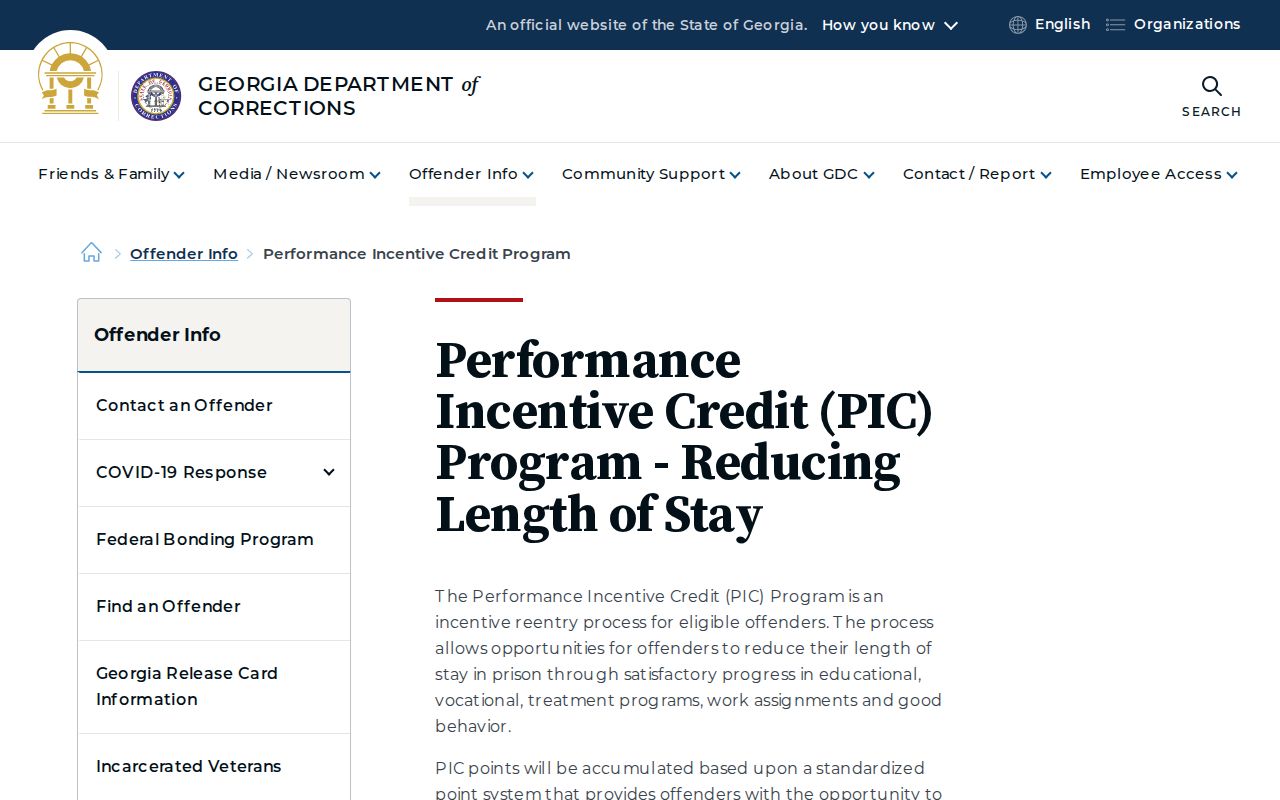
Use the program description as context, then verify the person's current date in the official offender record.
What Changes Twiggs Release Dates
A date can move for lawful reasons after it first appears. Some changes shorten a projected term, while others delay release or send the person to another custody system.
| Factor | Possible effect | Best source |
|---|---|---|
| Earned time or PIC | May reduce an eligible date | Jail or GDC |
| Disciplinary loss | May restore time to serve | Custody agency |
| New court order | May amend or replace the calculation | Sentencing court |
| Parole decision | May set, delay, or deny conditional release | Parole Board |
| Detainer or warrant | May cause transfer instead of community release | Release record and receiving agency |
| Sentence structure | Consecutive or concurrent terms alter the end date | Court and GDC |
A detainer is a request from another authority to hold or transfer a person. Leaving Twiggs custody under a detainer is not the same as returning home. Confirm the receiving agency through the release record.
Twiggs Bond Timing Is Different
Bond timing is not a projected sentence date. The Twiggs sheriff FAQ says bond may be issued just after booking or within seventy-two hours, based on the charges. That statement describes when a bond decision may arise. It does not promise that someone will post the bond or leave at a fixed hour.
The sheriff identifies cash bond, property bond, and a professional bondsman as possible paths unless the court orders cash only. Property bonds require office handling on weekdays between 9:00 and 5:00. Cash bond and the stated bond fee must be paid by money order. These local steps can affect the actual jail exit even though a pretrial detainee has no sentence expiration date.
A court may grant bond while another warrant or detainer still blocks community release. Read the bond order, ask the jail about holds, and call before travel. The reviewed official sources do not publish a standard Twiggs release door or daily release hour.
Twiggs Parole Date Review
Georgia parole dates also require careful labels. The Board says parole-eligible felony inmates in GDC custody receive automatic consideration, so no application is needed. A hearing examiner reviews the file and prepares a guidelines recommendation. Board members vote independently until a majority decision is reached.
A TPM may be set, changed, delayed for institutional conduct, or followed by a denial at final review. For serious violent felony non-life sentences with qualifying offense dates, the Board says parole is unavailable and the full prison term must be served. Life cases follow separate eligibility rules. The individual sentence and Board record control.
For Twiggs County, use the TPM lookup for an incarcerated state prisoner and Parolee Search only after parole begins. Neither tool supplies the county jail's earned-time calculation.
Confirm Twiggs County Release
VINE can send a custody-change alert when a matching person is available in the participating feed. Register while the person is still held. The VINE Inmate Check explains the notification path and its limits. An alert is useful, but it may not state the full legal reason for release.
For final proof, pair the alert with the record created by the jail, GDC, parole board, or court. A missing roster entry is only a clue. It may reflect release, transfer, or a data change. The full Twiggs County released inmate search gives the records-request and cross-system path.
- Maximum release date
- The calculated end of state custody under the sentence record.
- Tentative parole month
- A possible parole period subject to final review.
- Actual release
- The custody event documented after the person leaves that agency.
- Detainer
- A hold or transfer request from another authority.
Twiggs Release Record Details
The county release record is the best bridge between a projected date and what occurred. A focused written request should identify the full name, approximate booking date, booking number if known, and the specific fields sought. Ask for release date and time, release reason, bond details when applicable, sentence served, court case number, and any transfer destination or detainer notation.
Twiggs requires open-records requests in writing. The sheriff identifies Erica Snelgrove as records custodian at 478-945-3357 extension 156 and erica.snelgrove@twiggssheriff.org. Requests should include requester contact details and clear facts such as names, dates, times, and locations. The office states that the custodian responds within three business days with an estimated cost before processing.
Georgia law allows inspection and copying of public records unless an exemption or court order applies. It does not require an agency to create a new calculation or summary that does not exist. Ask for the existing jail, sentence, or release record instead of asking the sheriff to predict a date that only a court or GDC can compute.
Twiggs Court Date Evidence
The Superior Court sentence can explain the controlling term for a felony case. The clerk record may show the judgment, sentence length, concurrent or consecutive terms, probation, revocation, and later amendments. Reconcile the court order with the jail or GDC calculation because the court imposes the sentence while the custody agency applies credits and release rules.
For a fast pretrial release, Magistrate Court may hold the useful record. Its stated work includes first appearances, bond hearings, preliminary hearings, and arrest warrants. A bond order can explain why release became possible, but only the jail record confirms when county custody ended. Release on bond does not mean the charge was dismissed.
Court records may outlast a jail roster entry. If a person has vanished from current custody, use the docket and disposition to distinguish bond, sentence completion, dismissal, probation, or transfer. Keep the case number with later requests so similarly named people are not confused.
Twiggs Written Date Confirmation
When GDC information needs formal verification, its offender-search disclaimer directs written correspondence to Inmate Records and Information at PO Box 1529, Forsyth, Georgia 31029. Include the GDC identification number and the exact date field being checked. A maximum release date, sentence end date, and tentative parole month are not interchangeable, so name the field rather than asking for a generic release estimate.
For a county sentence, send the same focused question to the Twiggs jail records custodian and obtain the sentencing order from the clerk. Comparing both records can expose whether the difference comes from jail credit, earned time, a later court order, or a transfer to state custody. Preserve the response date because later conduct or official action can change a future calculation.